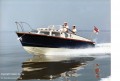
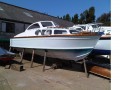
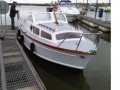
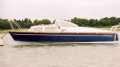
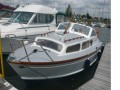
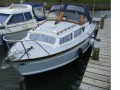
Fairey Huntress 23 with 200HP single diesel engine - NEW INSTRUCTION
Fairey Huntress 23ft
Ex Navy Captains Launch
LOA: 23ft
Beam: 8’ 3”
Draft: 2’ 10”
Hull & Deck: Hot Moulded & Marine Plywood
Model: Ray Hunt design Fairey 23ft ‘Huntress’
Builder: Fairey Marine, Hamble, Hants
ConstructionFairey Marine hot moulded Agba laminated hull.
The unique system of laminating veneers 2.5mm thick in Kola Blanka (Agba) with some six forming the bottom and five on the top sides, but this could varied to make the shell (hull) stronger as occurred with the Naval Boats.
The completed shell was formed on a wood block mould, pushed into an autoclave (oven) with steam applied, the heat set off the glue, while pushing down the assembled veneers covered in a rubber bag. A finished hull resulted in less than one hour.
These hulls were incredibly strong for their weight and the process started in the aeroplane industry, perfect for the early days of lightweight powerboats.
Engines were very heavy, slow revving and agricultural in the 1950/60’s, so the speed of the Fairey range was something exotic at the time, with the advent of the then high speed commercial diesel engines.
This hull number 175, yard number 6551 is an ex Navy Captains Launch, attributed to HMS London (D16- County Class Destroyer) and therefore has the advantage of being one of the later build and to the increased naval specification of hull laminates
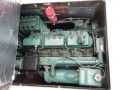
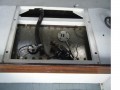
MachineryVolvo MD 200HP. 6cyl. marine diesel engine, driving a single shaft through a Borg Warner velvet 1:1 gearbox.
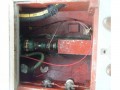
Engine seacock & raw water filter.
Bronze 17" equipoise three bladed propeller
Stainless steel Fairey Classic side scoops provide air to the engine bay
Single lever engine controls
Wheel steering to the Fairey bronze rudder. The whole rod and bevel box system was replaced by the previous owner 2007, at some expense.
Fuel Tank & system
Rod Steering
Electrics
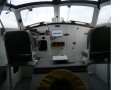
Twin batteries and 12volt electrics, laid to the dash panel with six fused switches.
Each battery has an isolating main switch with separate link switch fitted, this standard Fairey system gives backup starting.
Cabin lighting and Navigation lights.
Screen Wipers
Shore power
EquipmentSteering compass-Sestral Speed Grid
VHF - Horizon Eclipse DSC
Clipper Duet-Speed & Distance
Lowrance Elite 7M
Anchor & line.
Navigation lights
Flag staff
Raytheon radar with stainless steel mast (not currently fitted)
Fish finder
Fire Extinguisher
Electric bilge pumps
Accommodation/ Cockpit
Two cabin berths are upholstered with storage underneath.
The cabin would convert to a double with an infill.
Marine sea toilet with Blakes seacocks
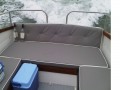
Aft bench seat with cushions for the all round aft. Perfect for those picnic days afloat
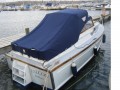
A spray hood and cockpit Tonneau covers
The engine box is removable for full engine access and doubles as a seat.
Deck Equipment
Usual complement of fenders, lines & warps, anchoring etc.
Hand rails on the cabin roof
Bow & Stern, spring cleats, Rope fairleads and bow anchor fitting- all classic Fairey.
Stainless steel bow push pit.
Fairey Bow badges
Manuel Bilge pump aft locker-1.5"
RemarksThis Huntress was built around 1970 and delivered to the Admiralty with a Perkins T6.354 marine diesel for use aboard the fleet as Captains personal launches.
They were particular popular as the ships company could water ski, and the often long distance from the anchored off warship could be covered quickly. One or two Huntress entered war zones such as the Falklands and other clandestine operations where their small size and exceptional sea keeping qualities made them extremely useful.
This launch was allocated to HMS London and demobbed in 1994 after duties as a Captain's training craft, normally in Dartmouth.
The current owner has a history file and details of past maintenance, together with a survey dated 23 February 2009 for himself, sadly the pressure of a growing young family has put this Huntress on the market
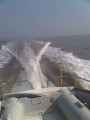
She should be considered a serious purchase with the 'up to date' Volvo 200HP 6cyl marine Diesel making her a gentleman's cruiser at say 20Knots with a maximum 25 knots.
She retains all those lovely classic details that make the Huntress not only a collectors classic boat, but also a craft that can be used afloat for enjoyment or family fun.
PedigreeHuntresses are an absolute cracker of a little seaworthy boat, the brain child of Ray Hunt the naval architect who must rank as having the largest number of craft afloat in both power & sail across the spectrum of yachting, his 'deep V' concept was a milestone in boating design.
The Hull form was licensed to Fairey Marine Directors Chichester-Smith & Currey by Ray Hunt in the 1950's, who had observed the hull form, whilst sailing 6 meters pre-war in USA . The Huntress had a slow start owing to the total lack of suitable engines, petrol being the only option, but the improved Perkins diesel was born and Sir Max Atkin started the Cowes Torquay race 1961, to principally foster improvements in small powerboats, so a whole industry of Pilot, Navy,Coastguard and domestic craft resulted. The Huntress 23 won 'Best all rounder' and 'Fuel economy' in the early races to Torquay.
The Bond film 'From Russia with Love' caused great interest in the Fairey Craft, the rich & famous just had to have one.
History of HMS London
HMS London (D16)
County-class destroyer of the Royal Navy. She commissioned in Swan Hunter's yard in Wallsend in 1963 under Captain J.C. Bartosik and initially was fully employed setting her armament to work, successfully firing her Seaslug for the first time off Aberporth in April 1964.
After working up, during which she entertained HRH The Duke of Edinburgh on board, in September 1964 she crossed the Atlantic to visit Bermuda and Houston before joining a special squadron led by Vice Admiral Sir Fitzroy Talbot on a round of visits to the South American part of his command.
Passing through Panama she visited Peru, Chile, Uruguay and Brazil before proceeding via Tristan da Cunha to Simonstown where she spent Christmas and New Year. She then deployed to the Far East, visiting Hong Kong, Bangkok and Subic, and Singapore and ports in Malaya.
During this time she was part of a powerful fleet whose presence acted as a deterrent to Sukarno's attempt to intimidate the infant Federation of Malaysia through 'Confrontation'.
HMS London was the last ship to leave Malta when the Maltese government closed the base. She was the last RN ship capable of firing Mark 1 Sea Slug missiles, and the last ship in Royal Navy to fire a four-gun broadside on 10 December 1981.
London was decommissioned in late December 1981 after completing a six-month West Indies Guardship deployment during which her crew were involved in the granting of independence to Antigua. Her Majesty the Queen was represented by Princess Margaret at the independence ceremonies.
HMS London was sold to Pakistan on 23 March 1982 and renamed 'Babur'. Babur was decommissioned from Pakistani service in 1993 and was sold for scrap in 1995.
She has been changed from the classic navay blue to a light blue in topside colour, the Captains launch archive illustration is of the first Huntress delivered to HMS Devonshire.